






















     |
United States Constitution
The United States Constitution. When did you last read it? How about the Declaration of Independence, or the Bill of Rights? It's important that each citizen read, and reread, these important documents. They are available to be read and understood by each of us. The United States Constitution isn't complicated. We don't need others to tell us what our founding documents say and mean. Too often other people let their own agenda and bias color their interpretation.
The United States Constitution and the other founding documents serve the people of the US in many important capacities. As a Constitutional Republic we look to these revered documents to play two primary roles: The United States Constitution stands as the supreme law of the US.
It limits the power of government.
Article two defines the powers of the administrative branch. Article three defines the powers of the judicial branch. The original draft was amended by the Bill of Rights. The Constitution was thought to be lacking in personal freedom guarantees by a majority of citizens as it was originally written. The first amendments were demanded by the people of several states before they would vote to adopt it. The Constitutional debate on whether it should be adopted as written, or amended and changed also resulted in the Federalist Papers being written and distributed publicly. These Papers offer interesting and important perspectives The above Yale University website link also contains many other important historical documents. The Bill of Rights enumerates certain rights of the people, and prohibits government from usurping those rights. From the very beginning, a philosophical struggle existed between those who advocated a strong central government (or even a monarchy) and those who opposed this "concentration of power" at the Federal level. Today, some people advocate applying the "spirit of the founding documents," rather than the literal meaning of the words in the documents. Others advocate that we adhere to the "letter of the supreme law" and interpret the documents in strict accord with the written words. It gets down to one fundamental question... Do the words really mean what they say? What do you believe? Our founding documents have served as the model for a number of other countries' founding documents... with varying degrees of success. It seems that interest, involvement, and commitment on the part of the people governed by these documents are as important as the documents themselves. For your convenience, here are the links again:..
United States Constitution Text Declaration of Independence And here's another interesting site: The National Archives website is a great place to explore
About This Site Have you read this page lately?
 Copyright � 2004-2006 Fred Doyle. All Rights Reserved.
|
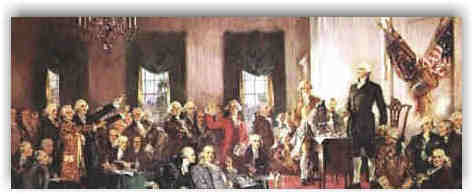
 The United States Constitution can be read and understood
by each
of us, using common sense. A little knowledge of history
also helps.
The United States Constitution can be read and understood
by each
of us, using common sense. A little knowledge of history
also helps.